01 The Hidden Engine of Human Behavior
Introduces the idea that recurring patterns in personal and social outcomes can be examined through exchanges and the capabilities they build or diminish.
A book about value, capacity, and cooperation
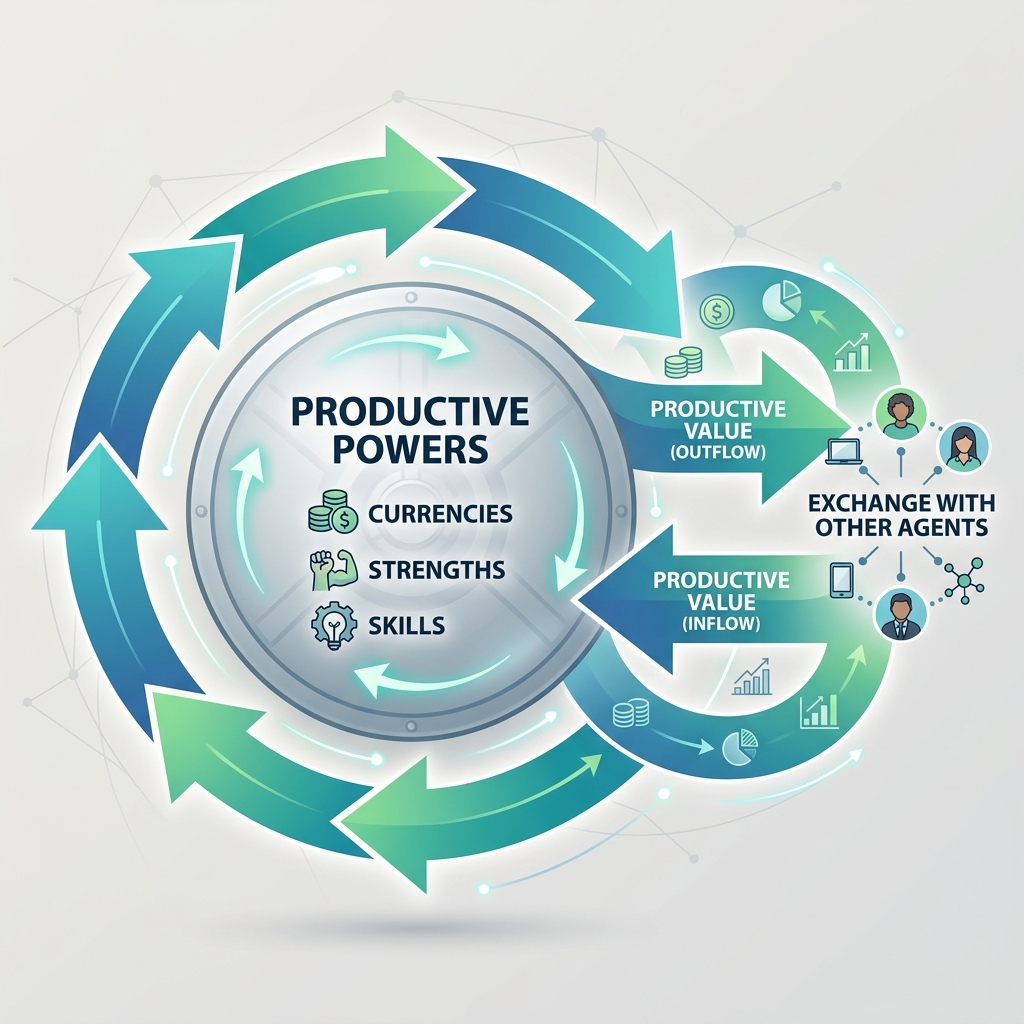
What we exchange matters. What those exchanges leave us capable of doing matters just as much.
Complete readable edition · Version 2.3, revision R59 · Free access
Selfish Cooperation examines human behavior through the exchanges that connect individuals, families, organizations, markets, and societies. People exchange far more than money and goods: labor, information, care, protection, instruction, and other forms of value. Trust and opportunity also shape those exchanges, though they are not automatically themselves Productive Value. These interactions can build capabilities, transfer them to others, or deplete them—even when they appear beneficial in the moment.
The book develops the Productive Value–Productive Power (PV-PP) framework to study those consequences. It moves from ordinary exchanges and individual psychology to cooperation, technology, families, institutions, conflict, and public authority. Its later chapters explore how the same questions apply when software agents act on behalf of people and organizations.
The distinction at the heart of the PV-PP framework is between the value an interaction produces now and the capacity that remains to produce value afterward. A profitable, efficient, or otherwise appealing action may still undermine future productive capability; conversely, investment, education, care, or restoration may strengthen that capability without an immediate equivalent return.
Value delivered, transferred, or realized through interaction—including goods, services, information, labor, care, and other useful contributions.
The actual capacity, under relevant conditions, to generate, coordinate, preserve, protect, and recover the ability to produce Productive Value.
The framework treats productive capability as multidimensional. Decisions must be evaluated against evidence, constraints, affected parties, potential harm, and the conditions needed for viable continuation—not just one immediate score.
Nineteen chapters trace the theory from everyday behavior to decision architecture and governed agency. Each chapter is summarized in one sentence.
Introduces the idea that recurring patterns in personal and social outcomes can be examined through exchanges and the capabilities they build or diminish.
Looks beyond money and goods to the information, effort, relationships, and other forms of value exchanged in everyday life.
Defines what is conveyed and realized in an interaction and explains why value cannot be reduced to monetary payment alone.
Develops the concept of the underlying capacity that makes productive action and future exchanges possible.
Explores how incomplete information, signals, and inference shape what people believe about their own and others’ capabilities.
Examines how accumulated experience and memory influence the interpretation of new interactions and future choices.
Connects perception and emotion to the way people assess alternatives and decide how to respond.
Presents the PV-PP framework’s decision architecture for evaluating possible actions against multiple viability dimensions and binding constraints.
Shows how cooperation and institutions create shared capacities that no participant could sustain alone.
Considers how technology amplifies, redistributes, substitutes for, and sometimes undermines productive capability.
Analyzes how social and institutional capacity grows, deteriorates, and can sometimes be rebuilt.
Explains how childhood, education, and long-term investment pass productive capabilities between generations.
Examines families and care relationships as structures that develop, pool, and transmit productive capacity.
Explores how relationships, reputation, obligations, and social standing influence access to productive opportunities.
Distinguishes cooperative exchanges from harmful, forced, and extractive interactions and considers their effects on productive capacity.
Examines markets and financial institutions as coordination systems shaped by incentives, information, risk, and power.
Addresses how public authority and institutions set and enforce the rules that enable—or constrain—collective productive activity.
Applies the PV-PP framework’s reasoning to delegated decisions and software agents, including authority, consequences, and continuing governance.
Draws together the book’s account of exchange, capacity, and the conditions needed for sustainable cooperation.
The full readable edition is available as a PDF in this repository. You can read it in your browser, download it, or print a personal reading copy.
Download Selfish Cooperation